The Buy Note
A household needs three knives: a chef knife, a paring knife, and a serrated bread knife. Everything beyond that is either a specialist tool you will recognise the need for when it arrives, or filler chosen to make a box look generous. The harder question is not which three to own — it is where the attention goes afterwards, and the honest answer is sharpening rather than steel.
The three that do the work
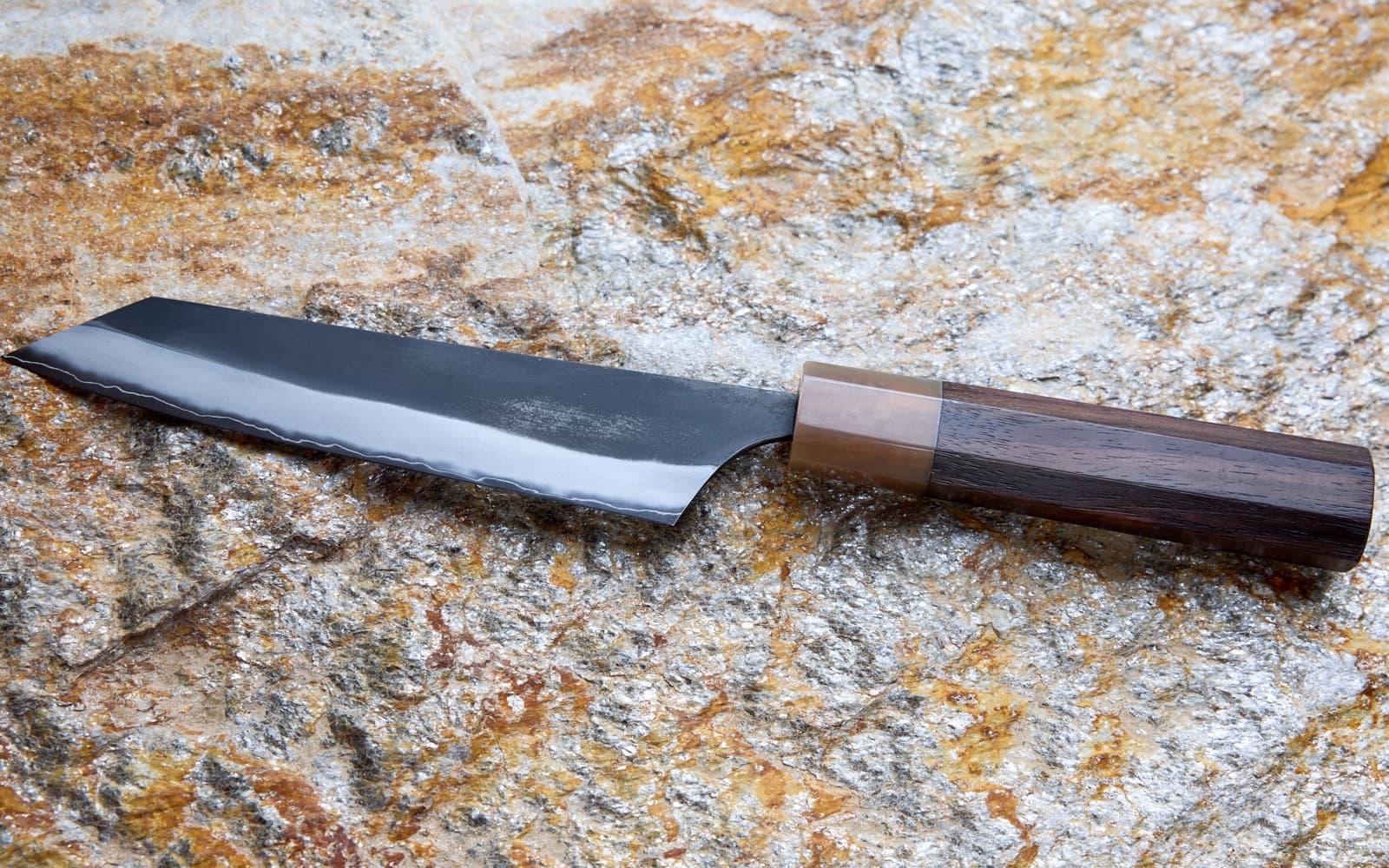
The chef knife does most of the cutting in most kitchens: onions, carrots, herbs, chicken thighs, the whole weeknight middle. An 8-inch blade is the common size and a 6-inch is easier for smaller hands and smaller boards, though a short blade means more strokes through a butternut squash. A santoku is the same tool with a flatter profile — it suits a push-cut, where a curved Western blade suits rocking. Neither is better; they reward different habits.
The paring knife is for work done in the hand rather than on the board: hulling strawberries, peeling a stubborn apple, trimming fat. A small job, but doing it with a chef knife is awkward and slightly dangerous.
The bread knife is the one place a straight edge is the wrong tool. Serrations saw through a crust, a tomato skin or a sponge cake without crushing what is underneath. It also ages best, because a serrated edge stays usable long after a straight one would need work.
| Knife | What it is for | What happens without it |
|---|---|---|
| Chef knife, 6–8 in | Board work: chopping, slicing, portioning | Everything takes longer and cuts less cleanly |
| Paring knife, 3–4 in | In-hand work: peeling, hulling, trimming | You use a chef knife at an unsafe angle |
| Serrated bread knife | Crusts, skins, soft cakes | Bread is compressed rather than cut |
Why the block of fifteen exists
A block is sold as a set because a set photographs as value. Count what is actually in one and the pattern is clear: the three useful knives, six steak knives, a pair of kitchen shears, a honing rod, and then a boning knife, a utility knife and sometimes a cleaver that most households will not pick up in a year.
The utility knife is the clearest example — too long for in-hand work, too short for the board, permanently in the wrong place. Steak knives are worth owning, but they are a table item rather than a preparation one.
The real cost of a block is not the storage. Whatever you spend gets divided across fifteen pieces instead of three, so the chef knife in a large set is nearly always weaker than the one you would have bought alone for the same outlay. The block itself is awkward to clean and sized for a collection you did not want.
Hardness, and what it costs
Steel hardness is measured on the Rockwell C scale, and it is the specification that explains most of the difference between two knives that look alike. Western-style knives are usually ground softer; many Japanese-style knives are harder. Harder steel takes and holds a finer edge for longer. It is also more brittle — it chips at the edge instead of rolling, and it takes more patience and better technique to bring back.
| Softer stainless | Harder stainless | Carbon steel | |
|---|---|---|---|
| Edge holds | Shorter | Longer | Longest, and keenest |
| Sharpening | Easy, forgiving | Slower, wants a whetstone | Fast, but rewards skill |
| Failure mode | Edge rolls, straightens on a rod | Edge chips, needs regrinding | Rusts and stains if left wet |
| Suits | Anyone not yet sharpening | Someone who will learn | Someone who dries it immediately |
Carbon steel is the one with a genuine catch. It takes an edge more readily than stainless, but it discolours with onions and acid and rusts if it sits wet in a sink overnight. If nobody in the house will reliably dry a knife the moment it is washed, that decision is made for you.
The handle is the part you judge in person
Handle fit is the one thing this guide cannot decide for you, because it depends on the size of your hand and how you hold a knife. If you use a pinch grip — thumb and forefinger on the blade itself, just ahead of the handle — a full bolster, the thick collar of steel where blade meets handle, gets in the way and stops you sharpening the last inch of edge near the heel. A half bolster or none avoids both. If you grip the handle alone, the bolster is a non-issue.
Beyond that: wooden handles feel better to many people and must be kept out of standing water; composite handles are inert and neutral. Balance is often described as a quality marker and mostly is not — a blade-forward knife suits a rocking chop, a handle-heavy one suits fine work, and neither is a defect. Hold the thing before buying it where you can.
A sharp cheap knife beats a blunt expensive one
This is the part that matters more than any of the above. Every edge dulls, at a rate set by what you cut and what you cut it on. A dull blade slips off a tomato skin instead of biting into it, and needs more force, which is the ordinary way people cut themselves in a kitchen. An inexpensive knife kept sharp is safer, faster and more pleasant than an expensive one that has not been touched since it was unwrapped.
Three tools do different things, and they get confused with each other:
- A honing rod straightens an edge that has rolled over. It removes almost no metal. Use it often — it is a maintenance habit, not a repair.
- A whetstone removes metal and creates a new edge. It gives the best result and takes real practice on scrap knives first.
- A pull-through sharpener is fast and consistent, and grinds away more steel than is ideal at a fixed angle that may not match your knife. A reasonable answer for a modest knife, a poor one for a hard Japanese blade.
What actually extends an edge is duller than any of that:
- Cut on wood or plastic. Glass, stone and ceramic boards ruin an edge in a single meal.
- Wash by hand and dry immediately. Dishwasher heat, detergent and knocking against other items all cost you.
- Store the blade so it touches nothing — a magnetic strip, an in-drawer tray, or a guard. A drawer full of loose cutlery is where edges die.
- Scrape the board with the spine, not the edge.
When three knives are two too many
If you cook rarely, or you are in a rented kitchen you will leave inside a year, one decent chef knife and a serrated knife is a complete answer and the rest is anticipation. The same holds if you are learning to cook: buy modestly, use it for a year, and let the things that annoy you tell you what to buy next. That is better information than any guide, this one included.
If you are certain you will not sharpen anything, let that pick the knife. Choose the softer, more forgiving stainless blade and a simple sharpener you will actually use, and skip the hard steel — it will be blunt within months and worse than the cheap knife you did not buy.
And if grip strength, tremor or joint pain is a factor, the ordinary advice inverts. A lighter blade with a thicker, textured handle, and a serrated edge doing more of the work, beats a heavy chef knife that demands a firm pinch grip. That is not a compromise, just a different set of constraints, and it deserves a knife chosen for it.