The Buy Note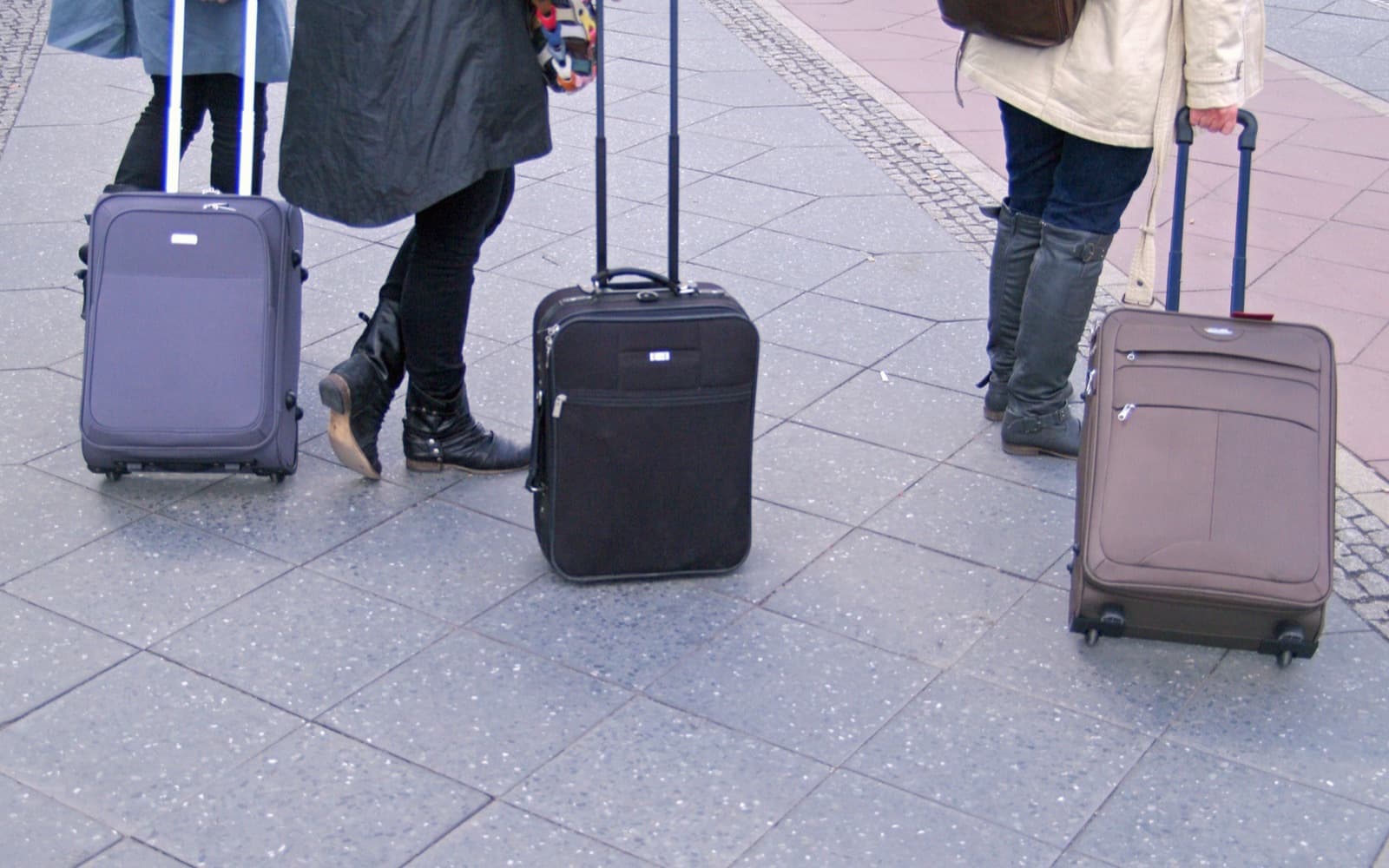
Cabin luggage is bought once and then dragged through whichever airline you happen to fly, so choose for the strictest limit you meet rather than the most generous. Beyond size, what matters is shell material, wheel count, and the two components that fail long before the case does. Empty weight belongs in the same conversation, because it comes out of the allowance you are protecting.
Buy for the tightest limit you actually fly
There is no international standard for cabin baggage. Each airline sets its own, and the numbers cluster into rough groups rather than converging. Mainstream limits sit near 55 x 40 x 20cm through to 56 x 45 x 25cm, and most legacy carriers are somewhere in that band.
Budget carriers are where it gets awkward. Several split the allowance in two: a small personal item that goes under the seat for free, at something closer to 40 x 30 x 20cm, and a proper cabin bag only if you pay for priority boarding. The under-seat dimension catches people out, because a bag sized to an overhead-locker limit will not go under a seat.
Two things follow.
- If you fly one airline almost exclusively, buy to its stated limit and stop thinking about it.
- If you fly a mix, find the smallest limit you meet more than once a year and buy to that. Legal everywhere beats legal on your favourite carrier and gate-checked on the other one.
Depth is the dimension airlines check hardest, because it decides whether the locker closes, and it is the one a soft bag can be over-stuffed into failing. A hard case that is 20cm deep stays 20cm deep; a soft case sold as 20cm is not, once the front pocket is full.
Check the measurement convention before comparing anything. Airlines measure the whole object as it stands, wheels and handle included; some listings quote only the shell.
Hard shell against soft shell
| Hard shell | Soft shell | |
|---|---|---|
| Fitting the sizer | Fixed dimensions, so it either fits or it does not | Compresses, but over-packs past the limit easily |
| Protection | Better for fragile contents and rain | Absorbs impact, but crushes |
| Packing | Two equal halves, both need repacking to reach anything | Front pockets reachable at the gate |
| Damage over time | Scuffs and cracks, and cracks do not repair | Frays and stains, but keeps working |
Hard shells come in polycarbonate, ABS and polypropylene. Polycarbonate flexes and returns; ABS is stiffer and cheaper, and more inclined to crack than bend at a corner impact. Polypropylene sits between them and tends to be the lightest.
The everyday difference is smaller than the material argument suggests. What you notice is that a hard case opens like a book, so getting a laptop out at security means opening both halves on the floor. A soft case with a front pocket does not. If your cabin bag is also your work bag, that pocket is the feature you use every trip.
Soft shells are nylon or polyester, and the denier number quoted describes thread thickness rather than durability. A high-denier fabric with a poor coating still soaks through.
Two wheels or four, and where you actually walk
Two-wheel cases are pulled behind you at an angle. The wheels are large and recessed into the body, so they cope with kerbs, cobbles and broken pavement and take up no space outside the shell. Every millimetre of the allowance is packing volume.
Four-wheel cases stand upright and push alongside you. On flat ground this is genuinely easier: the bag carries its own weight and your arm does very little. On anything uneven the small castors snag, and pushing a spinner over cobbles is worse than pulling a two-wheeler over them. The castors sit outside the shell, so at the same external limit a four-wheel bag holds less.
Choose on where you walk. Terminals and hotel corridors favour four. City streets, train platforms and kerbs favour two.
The handle and the zip are what break
Suitcases rarely die from the shell. They die from the telescopic handle and the zip, neither of which is easy to inspect from a photograph.
The handle is a set of nested aluminium tubes with a release button and internal stops. It fails as a wobble that grows until the bag steers badly, a stop that stops holding so the handle collapses mid-pull, or a button that jams. Fewer stages help, because a two-stage handle has fewer joints than a three-stage one, as does a handle that locks solidly at more than one height. Rock an extended handle side to side in a shop: that check takes ten seconds and tells you more than any specification.
Zips split into coil and chain. A coil zip is a continuous nylon spiral, cheaper and lighter, and it can be forced open with a blunt point and then re-zipped — a known security weakness, though the same property lets it self-heal when a tooth is displaced. A chain zip has separate metal teeth and resists that, at more weight. Either way, look at the size marking on the slider and the width of the tape. An under-sized zip on a bag packed full is the most common way a cabin case ends its life.
Wheel bearings are the third wear item. Sealed bearings run quieter and last longer; on a cheap bag the wheel is a moulded disc spinning on a rivet.
Empty weight, before you have packed anything
Many airlines cap cabin baggage by weight as well as size, commonly somewhere between 7kg and 10kg; some do not weigh at all. Where there is a cap, the empty weight of the case comes straight out of it.
A hard cabin case can weigh anywhere from under 2kg to over 4kg. That spread is not a rounding error — at the heavy end you lose a large slice of a strict allowance to the bag itself. Soft cases at the same external size are usually lighter, and the lightest options have no wheels or handle at all.
The trade is real. Lighter cases are thinner, use smaller wheels and simpler handles, and take rough handling less well. If your bag lives in an overhead locker and never gets checked, light is close to free. If it regularly gets gate-checked into a hold, it is not.
Weigh whatever you buy before your first trip, then weigh it packed. Guessing is how people find out at the desk.
When you do not need one of these at all
If you travel two or three times a year, mostly short trips, mostly in cities, a cabin suitcase may be the wrong shape entirely. A holdall or a travel backpack within the same dimensions weighs less, carries up stairs without a fight, squashes into an under-seat space a rigid case will not enter, and stores flat. The reason to own wheels is distance on smooth ground with a heavy load. If none of your journeys look like that, the wheels are dead weight for the whole trip.
The cheap case is the right case more often than the enthusiast conversation admits. If you fly rarely and pack light, a basic bag will survive years of that use, and a stronger handle answers a stress you never apply. Buy the sturdier one once you know you are hard on luggage — a broken handle or a split zip on a bag you liked is a better reason than a specification you read.
And if the bag you own is fine except that it fails one airline's sizer, a small under-seat bag for those flights costs less than replacing it.