The Buy Note
Most people buy one bag and use it for everything, which is why most people are mildly unhappy with their bag. A daypack, a one-bag travel pack and a wheeled cabin case are three different tools, and the honest answer is usually that you need two of them. Below are the long-lived options in each category and the trade-off each one asks you to accept.
Nothing here has been bought, opened or tested. These are picks made from what each product is built out of and designed to do, and from its reputation — not from anybody here having owned one.
Osprey Daylite
The Daylite is a small, simple daypack: one main compartment, a front scratch-free pocket, mesh side pockets, a light foam back panel. It has existed in more or less this shape for years and comes in a few sizes, including a plus version and a sling. It also attaches to the harness of Osprey's larger packs, so it works as a summit bag.
It suits the person who wants a bag for a book, a jacket, lunch and a water bottle — commuting, museums, a half-day walk.
The weakness is that it is genuinely small and lightly built. The hipbelt on the standard version is a thin webbing strap, not a load-carrying belt, and the shoulder straps are modest. Put a laptop, a camera and a day's water in it and you will feel every one of them on your shoulders. It is a light-load bag pretending to be nothing else.
Osprey Talon (and Tempest)
The Talon is Osprey's hiking daypack, and the Tempest is the women's-fit version of the same idea. It has a proper ventilated back panel, a moulded hipbelt with pockets, load-lifter straps, trekking pole attachments and stretch pockets you can reach while wearing it. It comes in several capacities and, importantly, in torso sizes — the fit is meant to be matched to your back, not guessed.
This is the pack for anyone who walks all day with weight: hill days, cycling commutes, long transits with a heavy load.
Two weaknesses. First, all that suspension is overkill in a city — it is a technical harness with straps to dangle and mesh to snag on the train. Second, the fit is the whole point, and a Talon bought in the wrong torso size is worse than a simpler pack in the right one. Buying it unseen is a real risk.
Worth saying plainly: Osprey's guarantee is a legitimate reason to pay more for one of these, because the company actually repairs bags instead of pointing at a receipt. The terms have been narrowed since the guarantee made its name, so check what covers the pack you are buying. Most warranty talk is noise; this is not.
JanSport SuperBreak
The SuperBreak is the plain, unstructured school backpack that has looked the same for decades: one big compartment, one front pocket, a straight-cut panel of polyester, a lifetime warranty against manufacturing defects. It is cheaper than everything else here and it is very hard to destroy through ordinary use.
It suits students, anyone who wants a spare bag that lives in a car boot, and anyone who resents spending real money on a bag that will be covered in badges within a month.
The weakness is that it has no structure at all. The base model has no padded laptop sleeve, no frame and no hipbelt, and the flat shoulder straps dig in once the load gets heavy. Fill it with textbooks and it becomes a sack. As a light-duty bag it is excellent; as a load carrier it is not designed to be one.
Peak Design Travel Backpack
Peak Design's travel pack is a 45-litre bag that cinches down to a smaller footprint, opens from the back and both sides, and is built around the company's modular internal cubes — camera cubes in particular. The weatherproof nylon canvas shell and the aluminium hardware are the visible reasons it costs what it costs.
It suits photographers and anyone whose kit needs organising rather than stuffing.
The weakness is weight and money. It is heavy before you put anything in it, the cubes that make the system work are bought separately, and if you are not carrying cameras you are paying for a modular system you will not use. It is also the most expensive pack in this piece, and its comfort at full load is good rather than exceptional.
Tortuga Travel Backpack
Tortuga makes packs for one purpose: carry-on-sized one-bag travel. The Travel Backpack opens flat like a suitcase, sits at the carry-on limit rather than beyond it, has a proper hipbelt and load lifters, and a laptop compartment reachable without opening the main body.
It suits the traveller who has decided never to check a bag again, and who packs clothes rather than gear.
The weakness is that it is a suitcase you wear, not a hiking pack. The boxy shape carries less well than a tapered harness once you are past a moderate load, and it does not compress down for use as a daypack. It is also heavy before you put anything in it — the sailcloth versions especially — which you pay for at every airline weigh-in.
| Pack | Best for | Carries heavy loads | Main compromise |
|---|---|---|---|
| Osprey Daylite | Light days out | No | Minimal suspension |
| Osprey Talon / Tempest | Walking with weight | Yes | Technical, needs fitting |
| JanSport SuperBreak | School, spare bag | No | No structure or padding |
| Peak Design Travel | Camera kit, organisation | Moderate | Heavy, cubes cost extra |
| Tortuga Travel | One-bag flying | Moderate | Boxy, single purpose |
Samsonite hard-shell cabin cases
Samsonite has been making luggage for well over a century, and its hard-shell cabin lines are the default answer for a reason: polycarbonate or ABS shells, spinner wheels, a warranty structure that actually exists, and enough retail presence that you can pick one up and squeeze it before buying.
It suits the person who wants a case that protects what is inside and does not want to think about it again.
Two weaknesses. The model names churn constantly — a line you researched may be renamed or replaced next season, so read the specification rather than trusting a remembered name. And the cheaper ABS shells are noticeably more brittle than the polycarbonate ones; if you buy at the bottom of the range, expect cracks eventually.
Away carry-on
Away's cabin cases are polycarbonate hard shells with four spinner wheels, a compression panel inside, a laundry bag, and a design that is deliberately plain. The fixed two-side interior is more useful than it sounds: it stops the case turning into one heap.
It suits frequent short-haul flyers who want a smart case and a fixed way of packing it.
The weakness is the finish and the wheels. Glossy polycarbonate scuffs visibly, and four small spinner wheels are poor on cobbles, gravel and kerbs — they are optimised for airport floors. The fixed interior also means you cannot pack a bulky, oddly shaped object without fighting the case.
| Hard shell | Soft shell | |
|---|---|---|
| Protects breakables | Better | Worse |
| External pockets | Rarely any | Usually several |
| Overpacking tolerance | None | Some |
| Scuffs and cracks | Shows scuffs, can crack | Absorbs abuse |
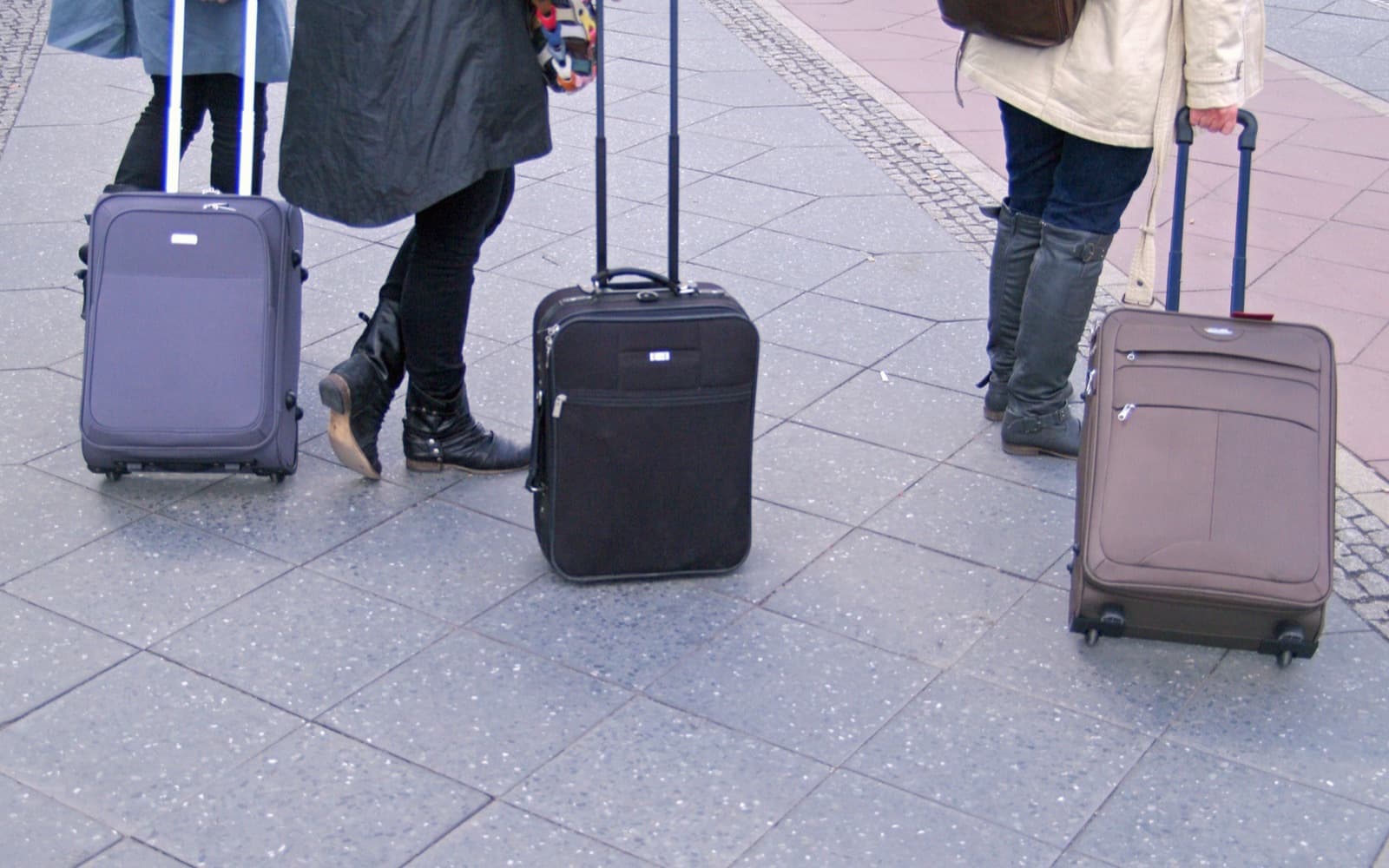
Two wheels versus four is the other real axis. Four spinners glide on smooth floors and let you push rather than pull. Two recessed wheels are tucked inside the shell, survive kerbs and rough pavement, and cannot be snapped off by a baggage belt. City streets and old towns favour two; terminals and hotels favour four.
When none of these is the right answer
If you carry a laptop and lunch between a train and a desk, almost any well-made bag with a padded sleeve will do, and the generic one is the sensible buy. The same goes for a case you use twice a year: a cheap hard shell stored in a wardrobe outlives an expensive one dragged through airports weekly.
Spend the money in two places only. First, when the bag carries weight on your body for hours — that is where a fitted harness earns every penny. Second, when the bag is used weekly for years, where a repairable product and a real warranty beat a lower price. Everywhere in between, buy the cheap one and put the difference towards the trip.